
Total cost of ownership, handling efficiency and sustainability — how to pick the optimal packaging format for your industrial chemical supply.
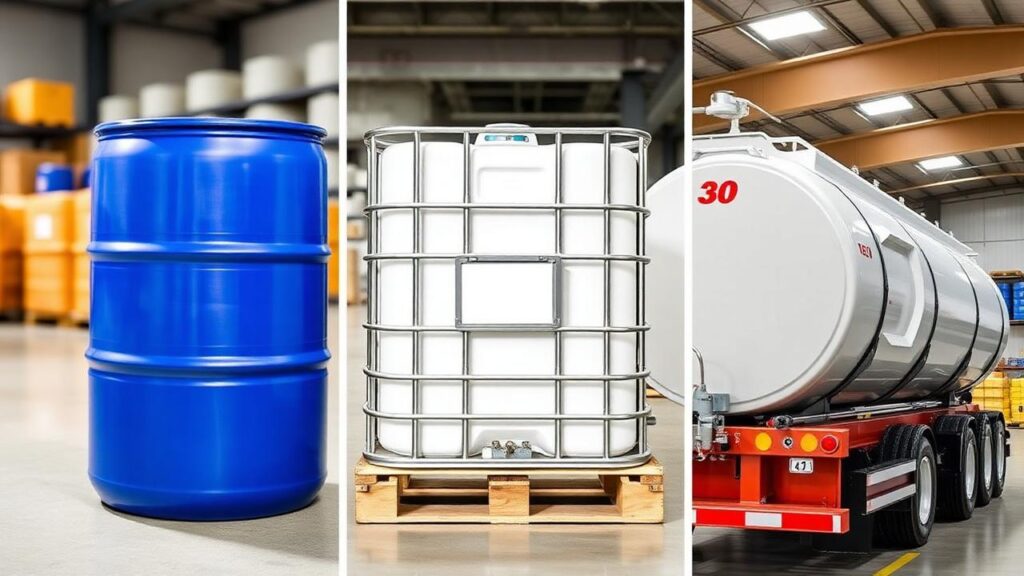
When you order industrial chemicals in the UK, the packaging format is rarely just a logistical detail — it directly affects price per litre, on-site handling time, waste disposal cost and your environmental footprint. This guide compares the three dominant formats: 25–200 L drums, 1000 L Intermediate Bulk Containers (IBCs) and bulk road tankers.
Drums (25 L to 200 L)
Drums are the most flexible format and remain the right choice for low-volume users, multi-site operators, or chemicals consumed in small batches such as laboratory reagents and specialty additives. HDPE drums are corrosion-resistant and lightweight; steel drums are essential for solvents and flammables. The trade-off is a higher cost per litre and a recurring waste stream of empty drums to manage.
1000 L IBCs
The 1000 L IBC is the workhorse of UK chemical distribution. A composite IBC (HDPE bottle in a galvanised steel cage on a pallet) reduces handling time dramatically — one forklift movement replaces five drum movements — and cuts packaging cost per litre by 30–50% compared with 200 L drums. Returnable IBC schemes go further, eliminating disposal costs and supporting ISO 14001 commitments.
Bulk road tankers
For consumption above roughly 5,000 L per month of a single product, bulk tanker delivery direct to a site storage tank is almost always the lowest cost per litre. It also eliminates packaging waste entirely. The capital trade-off is the on-site infrastructure: a chemically appropriate storage tank, bunding to 110% capacity, a dosing or transfer pump, and operator training for tanker offloading.
Total cost of ownership
When comparing formats, look beyond the price per litre. Factor in: forklift and labour time per delivery, pallet and packaging disposal costs, the working capital tied up in larger stockholdings, and the cost of any specialist equipment such as IBC dispensing frames or tanker offloading manifolds. For most UK manufacturers consuming 1,000–10,000 L per month of a given chemical, IBCs hit the sweet spot.
Sustainability considerations
Returnable IBCs and bulk tanker delivery dramatically reduce the carbon footprint and waste stream of your chemical supply. If you are working towards ISO 14001 or science-based emissions targets, switching from drums to IBCs is one of the highest-impact, lowest-effort improvements you can make.
Talk to Prestige
Prestige Chemicals supplies the same products across all three formats, with returnable IBC schemes and bulk tanker delivery available on request. Contact our team for a packaging review and total cost of ownership analysis.